Pinocchio’s creation and first escape
The Adventures of PinocchioPinocchio’s creation and first escape turn a common block of firewood into an unruly Marionette and immediately set a father and son on opposing paths. The episode establishes the story’s basic contradiction: Geppetto makes Pinocchio and tries to teach him, but Pinocchio’s first new freedom is to run away. Their separation begins not with a deliberate break between equals, but with a lesson in walking that ends in a street, a crowd, and Geppetto being taken to prison.
From firewood to Marionette
The story opens by overturning the expectation of a royal beginning: Pinocchio starts as an ordinary, inexpensive piece of firewood, the sort burned to warm a room in winter. The narrator frames the wood as uncanny—it has wept and laughed like a child—and says that, though the cause is unknown, it eventually finds its way into the workshop of Mastro Antonio. This humble origin makes Pinocchio’s animation less like a carefully planned marvel than an inexplicable fact confronting ordinary working people.
Mastro Antonio passes the wood to Geppetto, who takes it home and begins carving. His room is small but neat, furnished with an old chair, a rickety bed, and a tumble-down table. A painted fireplace and a painted pot supply the image of domestic warmth without a real fire or meal. Against this spare background, Geppetto makes the Marionette by shaping his hair, forehead, and eyes. The eyes move and stare at him even before the work is complete, giving the wood a presence that exceeds its maker’s control.
Geppetto names his creation Pinocchio and hopes the name will bring good fortune. His reasoning is wry: he remembers a family of Pinocchios whose members were all lucky, though even the richest had to beg for a living. The joke punctures any confidence that a name can determine a future. Geppetto is making a son and imagining his prospects, but the new Marionette is already acting on his own.
Learning to walk, then running away
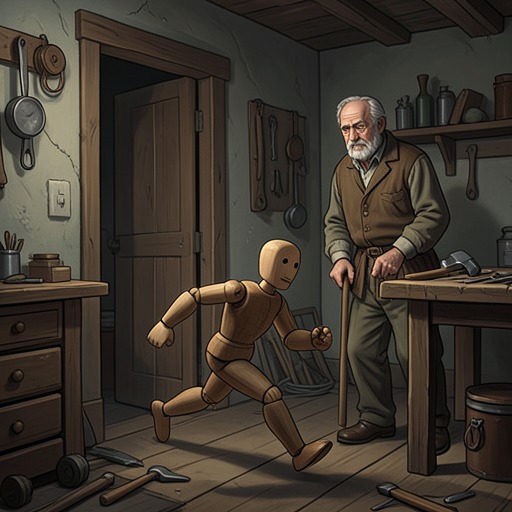
Once Geppetto has made the legs and feet, Pinocchio delivers a sharp kick to the tip of his nose. Geppetto takes the blow as something he has earned, regretting that he did not think more carefully before making the Marionette. The moment gives their relationship its first comic reversal: the creator has finished the body, but cannot prevent it from striking back. His response is not to abandon the task. He lifts Pinocchio under the arms, sets him on the floor, and holds his hand while demonstrating how to put one foot in front of the other.
At first Pinocchio’s legs are stiff. Once they loosen, however, he walks without help, races around the room, and darts through the open door into the street. The speed of the change matters: a lesson intended to make him mobile becomes the means by which he escapes. Geppetto runs after him, but Pinocchio’s leaps carry him beyond reach; his wooden feet clatter on the stones so loudly that they seem to make the noise of many peasants in wooden shoes. His flight is both a child’s sudden mischief and the first clear demonstration that Geppetto’s care cannot simply direct his actions.
The street reverses the family story
The people who witness the chase do not understand it as a father trying to recover the Marionette he has just made. They stop to stare and laugh at the sight of a wooden figure running like the wind. A Carabineer, hearing the commotion and supposing that a runaway colt may be loose, steps into the street to stop it. Pinocchio tries to slip between the man’s legs, but the Carabineer catches him by his conspicuously long nose and returns him to Geppetto.
The reunion does not settle the matter. Onlookers assume that Geppetto is cruel and that Pinocchio needs protection from him. Their intervention reverses the episode’s actual history: the old carpenter has made the Marionette, tried to teach him to walk, and pursued him when he fled, yet the crowd casts him as a tyrant. The Carabineer frees Pinocchio and takes Geppetto to prison. Unable to defend himself, Geppetto weeps and laments that he had tried so hard to make Pinocchio well behaved, while also blaming himself for not having thought the matter through. Pinocchio’s escape therefore leaves him free but separates him from the person who made and cared for him.
The beginning of a recurring pattern
The episode’s consequences extend beyond this first separation. Pinocchio later recalls that everyone warns and advises him, including the Talking Cricket, but dismisses the dangers of going on alone before encountering the Assassins. That later defiance echoes the first escape: warnings are treated as restrictions, and independence is mistaken for immunity from danger. The initial flight thus plants a pattern the adventures will repeatedly test, rather than resolving Pinocchio’s struggle between impulsive freedom and the guidance offered by others.
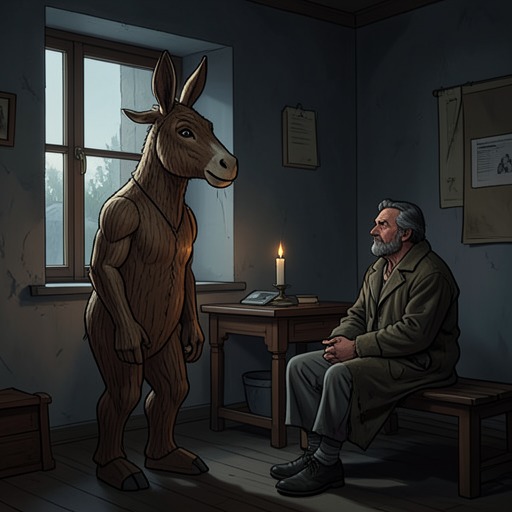
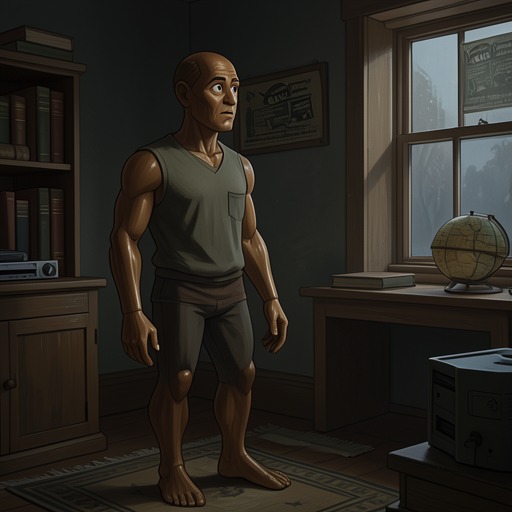
His identity as Geppetto’s Marionette also persists in later public scenes. At the Marionette Theater, the performers recognize Pinocchio as their brother and celebrate him, while the arrival of Fire Eater turns their welcome into a danger to his life. Much later, when Pinocchio is advertised as the famous donkey in a circus performance, he recognizes The Fairy with Azure Hair in the audience by the Marionette portrait on her medallion. These scenes place his wooden origins inside a life of performance and changing bodily forms, but they do not erase the first bond established in Geppetto’s small room. When Pinocchio eventually finds Geppetto again, he throws his arms around his father and promises never to leave him. The first escape begins the separation; the later reunion gives that beginning its emotional measure.